Get Coding for a Chance to Win £3,000 – Payara Hackathon ‘Generative AI on Jakarta EE’ is On!
Jakarta EE
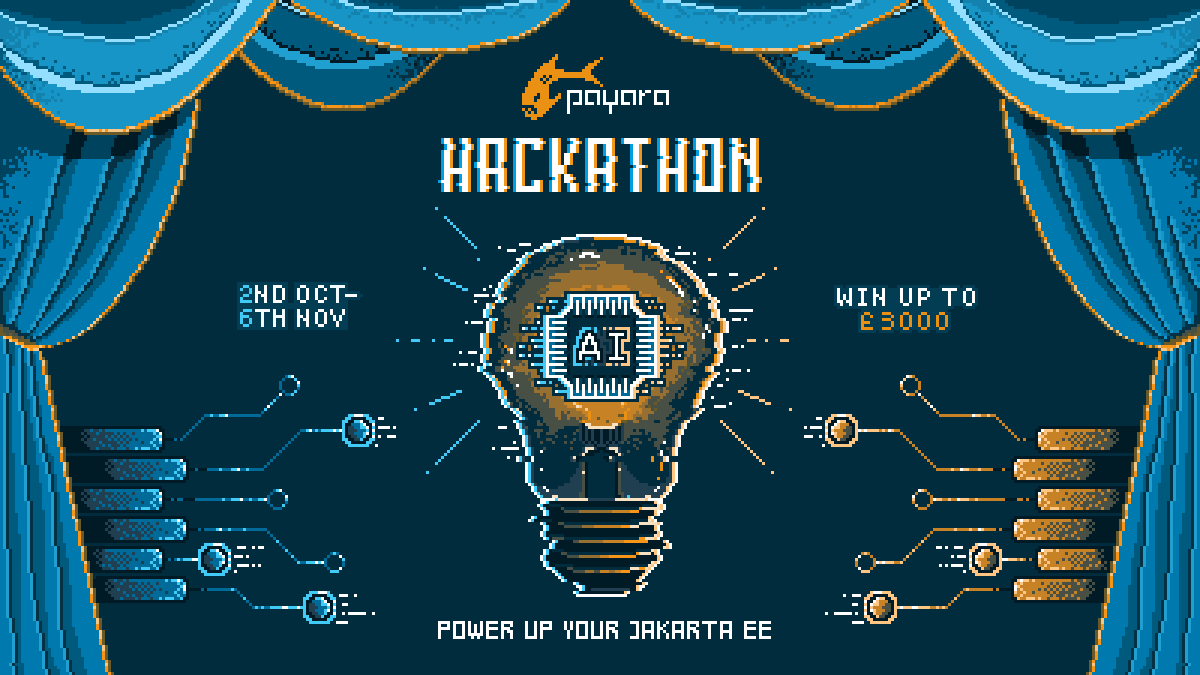
We’re excited to announce that the 3rd edition of Payara Hackathon is now open for sign ups! Find out more !
The Payara Hackathon – Generative AI on Jakarta EE – will be running from the 2nd of October until the 6th of November and this time, we are challenging you to push the boundaries of enterprise Java development to create futureproof applications. This hackathon gives you the chance to create and showcase ground-breaking applications that harness the power of Generative AI within the Jakarta EE platform.
Whether you’re passionate about AI or a driven Java developer, this is your chance to innovate and help us showcase how Jakarta EE is a valuable solution for developing tomorrow’s apps. Winners will be spotlighted across our platforms, earn money prizes, and present their solutions to a worldwide audience.
Your Mission:
Develop a prototype or proof-of-concept application that seamlessly integrates Generative AI with the Jakarta EE platform, demonstrating practical use cases for AI in real-world enterprise environments.
Why Participate?
Expand your network: Work solo or team up for a multidisciplinary approach, welcoming participants globally.
Advance the community: A chance to innovate, push the limits of Jakarta EE, and gain recognition for your solutions.
Gain international recognition: Winners will be spotlighted across our platforms, earn money prizes, and present their solutions to a worldwide audience.
Share:

 7 minutes
If you worked with MicroProfile Health, you already understand the value of exposing application health information through standardized endpoints. […]
 1 minute
Modern high-frequency trading (HFT) platforms operate under extreme performance constraints, processing tens of thousands of messages per second while […]
 1 minute
Earlier this week, we’ve launched the 2026 Payara Platform Community Survey and we’d love to hear from you. If […]