What’s new in Payara Server & Payara Micro 4.181?
Cloud & Microservices
Payara Server and Payara Micro 4.1.2.181 have finally hit, and here’s some of the biggest features, as well as some important announcements.
Also released in 5.Beta2 (download here), we’ve included support for MicroProfile 1.2, which includes:
You can find a related blog from Mike Croft on using Fault Tolerance with Payara Micro here. It’s focused on Payara Micro 5, but it should also work on Payara Micro 4.1.2.181.
This release also includes a number of simple usability improvements, which hopefully make Payara Server & Micro easier to use.
These include a more accurate message for if you execute the stop-domain command without any domains running, a configurable timeout parameter for when starting instances, not having to specify the –deploy parameter for Payara Micro, and the ability to stop the server logging to a file.
For a full list of fixes, features and improvements, see the Release Notes.
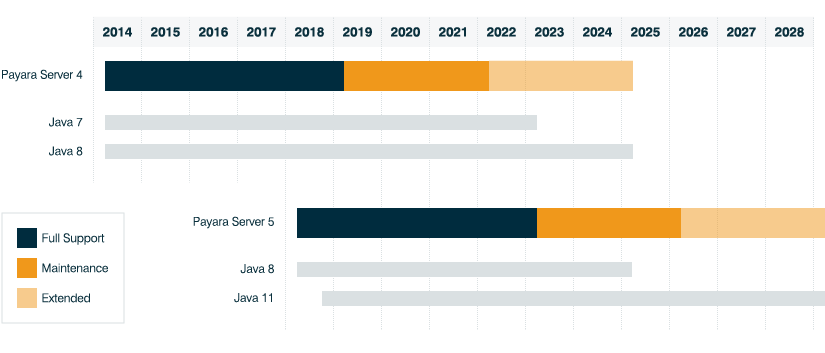
Sadly, or excitingly depending on your outlook, 4.181 will be the last public release of Payara Server & Micro in the 4.x Community stream; next month will (hopefully!) see the release of Payara Server & Payara Micro 5.181! In line with this, the master branch on GitHub will shortly be shifting over to Payara 5, and a new Payara-4 (or similarly named) branch will be created for any additional maintenance fixes.
If you need continued support for Payara Server 4.x and/or Payara Micro 4.x, please take a look at our paid Support Services – these provide support for Payara Server 4.x; Payara Micro 4.x and Enterprise Zulu JDK 8 through until 2024.
Find out more about the Payara Support Lifecycle
New Feature Stream releases for Payara Server 4.x and Payara Micro 4.x will also continue for support customers along with the usual Stability Stream releases.
For more details, check out the Support Services and Support Lifecycle pages.
{{cta(‘f53ec10a-12d5-483b-b089-2d4cdab10448’)}}
 4 minutes
The March 2026 release brings important platform modernization, stability improvements, and comprehensive bug fixes across the Azul Payara Platform […]
 7 minutes
If you worked with MicroProfile Health, you already understand the value of exposing application health information through standardized endpoints. […]
 1 minute
Modern high-frequency trading (HFT) platforms operate under extreme performance constraints, processing tens of thousands of messages per second while […]


Thanks for the new release. Not sure if you already caught it, but README for 181 still shows 174.
Gah! We hadn’t caught it, no.
Thanks!